
https://www.alength.com/the-ultimate-guide-to-mountain-systems-geology-climate-and-hydrology/
Mountains, these magnificent masterpieces of nature, often make people feel awe. They stand on the surface of the earth like silent watchers, experiencing billions of years of wind, frost and changes. Among them, volcanic eruptions are an important driving force in the formation of mountains. Every eruption seems to be the venting of nature’s anger, or the burst of her creative power. So, how are volcanic eruptions closely related to the formation of mountains?

Volcanic Eruptions: The Earth’s Heart’s Cry
A volcanic eruption is not just the momentary magnificence of magma gushing out, it represents the release of energy deep inside the earth. Can you imagine? Deep inside the earth, magma and gas are constantly accumulating, waiting for a moment of release. When two crustal plates change due to mutual compression or collision, the underground pressure gradually increases, and eventually the unbearable pressure causes the magma to break through the crust and erupt. Every volcanic eruption is nature challenging our understanding of it. How can it set off such a turbulent wave from the calm rocks?
Sometimes, the scale of a volcanic eruption is enough to bring disaster to the surrounding creatures, but sometimes, the erupted volcanic ash and lava become new fertile soil after a long time. The amazing thing is that these lava flows that once brought disasters eventually brought new life to the earth. What kind of power allows the earth to give birth to such a rich ecology from disasters?
The formation of volcanic mountains: the dance between lava and ash
The formation of volcanic mountains is like the process of the earth carving itself. When a volcano erupts, lava flows and covers the earth, quickly cools and becomes hard rock. Every eruption reshapes the surface of the earth. Imagine that for hundreds, thousands, or even millions of years, volcanoes erupt again and again, piling up layers of lava into mountains, gradually raising the once flat land, and eventually forming majestic volcanic mountains.
Look at the Hawaiian Islands. These beautiful islands were not created overnight, but were formed by the continuous eruption of volcanoes and the accumulation of lava. These islands are made up of volcanoes, and each eruption adds new layers to these islands. Their majesty did not happen overnight, but was a miracle carved out by the earth with hot flames over and over again over the long years.
However, volcanic mountains are not just simple accumulations of lava. They have various structures. Some volcanic eruptions will form typical conical mountains, such as Mount Fuji, whose perfect cone shape makes people marvel at the ingenuity of nature. Some volcanoes have more complex structures. The magma erupted again and again, eventually creating layers of volcanic bodies, forming a larger mountain system.

Typical features of volcanic mountains: cone shape and layers
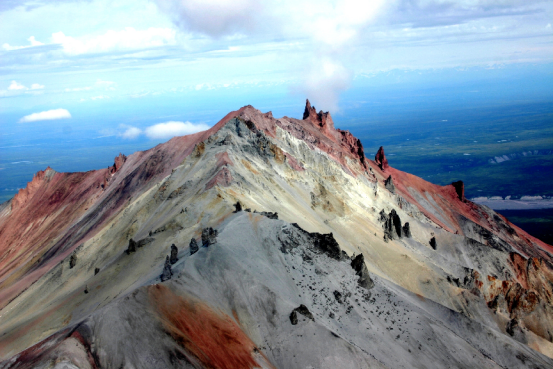
The biggest difference between volcanic mountains and other mountains formed by crustal movement is perhaps the towering, conical peaks that point straight to the sky. These peaks seem to speak of the power and majesty of volcanoes. Have you ever looked up at those stunning volcanic mountains in the embrace of nature and felt an indescribable shock? Doesn’t the wonderful process from lava to rock accumulation, from volcanic eruption to the rise of mountains make people feel a primitive shock?
The top of a volcanic mountain usually forms a crater, and craters are often the places with the most life. Have you ever imagined how the cooling lava after a violent eruption will form a new ecology around the crater? Sometimes, during a volcanic eruption, magma may accumulate water in the crater, forming a lake, further changing the appearance of the mountain.
Interactions between volcanoes and mountains: magma, tremors, and rebirth
The formation of volcanic mountains is often not isolated. The movement of the earth’s crust and volcanic eruptions often occur at the same time. Imagine that when the earthquake shakes the ground, magma rises from deep in the earth’s crust and flows out through fault zones. This interaction between earthquakes and volcanic activity often causes the shape of mountains to change dramatically. At that moment, the entire face of the earth seems to be changing dramatically. And it is in this unstable geological environment that mountains can gradually rise from the ground and be magnificent.
Have you ever wondered why volcanic activity is so frequent in some places? Why do volcanoes erupt in certain areas? In fact, it is closely related to the movement of the earth’s crust. It is this powerful geological force that drives the formation of mountains and allows us to see these volcanic mountains with a long history today.

Volcanic mountains and ecology: from ruins to rebirth
The birth of volcanic mountains is often accompanied by a process of destruction. Magma flows, volcanic ash spreads, and the surrounding plants and animals often face the fate of extinction. However, surprisingly, the land after the volcanic eruption can recover within hundreds or even thousands of years. You can’t help but ask: What kind of miracle is this? How did those lives that were once destroyed rise again on the ruins of the volcano?
As the magma brought by the volcanic eruption cools and the volcanic ash is deposited, new plants gradually begin to take root and sprout in the soil. After a long time, this land baptized by the volcano eventually becomes fertile and rich, becoming the cradle of new life. Have you ever seen the new forests after a volcano? They form a sharp contrast with the surrounding environment, as if they are a miracle of nature’s rebirth.

Conclusion: From volcanoes to mountains, the miracle of earth evolution
Volcanic eruptions and the formation of mountains are one of the most amazing miracles of nature. Every eruption is an explosion of the power of nature; the rise of every mountain has witnessed the changes of the earth for billions of years. From the flow of lava, to the accumulation of rocks, to the rebirth of ecology, it seems that nature is creating history in its own way. Standing in front of these volcanic mountains, we can’t help but sigh: This is not only the pride of the earth, but also a witness to her deep history.
https://www.alength.com/the-ultimate-guide-to-mountain-systems-geology-climate-and-hydrology/